Writing to England in 2014: the arguments put to English readers during the independence debate
In the final weeks before the vote of 18 September 2014, a striking genre appeared on the Yes side: the open letter to England. Its authors were often people born in England who had made their homes in Scotland, and their aim was to explain the independence movement to friends and relatives south of the border, who mostly followed the campaign through London-based newspapers and broadcasters. This article looks at the arguments those letters made and checks them against what is known today.
Key facts
- Referendum: 18 September 2014; question "Should Scotland be an independent country?"
- Result: No 55.3% (2,001,926 votes), Yes 44.7% (1,617,989); turnout 84.6%.
- Franchise: people resident in Scotland, including British, Irish, EU and Commonwealth citizens, from the age of 16. Scots living in England had no vote; people from England living in Scotland did.
- England-born residents: about 459,000 people, roughly 8.7% of Scotland's population, at the 2011 census.
Why write to England at all?
The 2014 referendum was decided only by voters in Scotland, yet its consequences would have reached the whole of the United Kingdom. English voters had no ballot but they had opinions, and many of those opinions were formed by commentary that the Yes side considered hostile or simply uninformed. A letter "to England" was therefore less a piece of campaigning aimed at voters than an attempt to change the tone of the conversation between the two countries. It also served a second audience: the several hundred thousand English-born people living in Scotland, who did have a vote and who were, as surveys later showed, among the least persuaded groups in the electorate.
The letters of that summer tended to follow a common structure. They listed the claims the authors believed English readers had been told, answered each one, and ended with an appeal to friendship between equal neighbours. Four claims came up again and again.
Claim one: the movement is driven by hostility to the English
Broadcasters and columnists in London regularly asked whether anti-English sentiment lay behind the demand for independence. The reply from English-born Yes supporters was that their own experience contradicted it: they had campaigned on streets and doorsteps with English accents and met little or no hostility. Their underlying argument was the distinction between civic and ethnic nationalism, discussed in more detail in our article on nationalism. The referendum franchise itself supported their point: it was based on residence, not birth or ancestry, so an English nurse in Inverness voted while a Scottish banker in London did not.
The evidence on attitudes is more mixed than either side's rhetoric. Social attitudes surveys found that most people in Scotland held a Scottish identity strongly, but also that hostility towards English people was a minority view and that it was not a strong predictor of a Yes vote once other factors were taken into account. Incidents of abuse did occur on both sides of the campaign, and both campaigns condemned them.
Claim two: Scotland is subsidised by English taxpayers
The "subsidy junkie" charge rested on the fact that identifiable public spending per person in Scotland has long been higher than the UK average, partly through the workings of the Barnett formula, the mechanism created in the late 1970s to adjust the Scottish block grant when spending changes in England. Yes supporters answered with the government's own statistics. The annual Government Expenditure and Revenue Scotland (GERS) report showed that, once a geographical share of North Sea oil and gas revenue was counted, revenue per person in Scotland had been close to or above the UK average in years of high oil prices.
Both sides were selecting from the same data. GERS also showed that Scotland ran a notional deficit in most years, and after oil prices fell sharply from the autumn of 2014 that deficit became considerably larger than the UK's as a whole. Whether higher spending is a "subsidy" depends on what one compares it with: the UK's own fiscal position, an independent Scotland's hypothetical one, or simply the needs of a country with a scattered rural population.
Claim three: Scotland has little to offer
A third set of letters answered the suggestion that Scotland lacked the economic base for independence. They pointed to the oil and gas industry, whisky exports, financial services, universities, renewable energy potential and tourism. These were real assets. The weaker part of the argument was the dependence on oil revenue, which is volatile; the Scottish Government's projections in its 2013 white paper, Scotland's Future, assumed prices that collapsed within months of the vote.
Claim four: independence would hurt England as well
On 13 February 2014 the Chancellor, George Osborne, announced that the UK government would not agree to a formal currency union with an independent Scotland, a position backed by Labour's Ed Balls and the Liberal Democrat Danny Alexander. Yes supporters writing to England argued that such a refusal would harm English businesses as well as Scottish ones, and that the two countries would remain each other's closest trading partners. Those who wrote to England also argued the reverse of the usual fear: that a self-governing Scotland might strengthen the case for reform in England, from the voting system to the House of Lords.
Pensions and everyday worries
Many of the questions English-born residents brought to Yes stalls were practical: what would happen to state and occupational pensions, to the NHS, to passports and to family visits across the border. The Scottish Government said that state pensions would continue to be paid at least at the same level, and that dual nationality would be possible. The UK government's view was that pension arrangements, especially for cross-border occupational schemes, would need negotiation. No answer could be definitive before negotiations that never took place, which is one reason the issue remained a strong argument for caution among older voters.
How did English-born voters actually vote?
The letters were written partly to persuade English-born voters in Scotland, and the evidence suggests that most were not persuaded. A study led by Ailsa Henderson at the University of Edinburgh found that a majority of people born in Scotland voted Yes, while roughly seven in ten of those born elsewhere in the UK voted No. Those figures come from survey data and carry a margin of error, but they are consistent with polling during the campaign. Even so, they also show that tens of thousands of English-born residents did vote for independence, which was the point the English Yes supporters most wanted to make.
What the letters tell us now
Read today, the open letters of 2014 are a record of a particular moment: a campaign in which the definition of who belonged to Scotland was civic and residential, and in which a minority of English migrants tried to show that national identity and constitutional preference did not have to coincide. Their economic arguments aged unevenly, as the oil price fell and the Brexit referendum of 2016 changed the terms of the debate. Their central claim, that support for independence was not a rejection of English people, remains the claim that supporters of independence most often repeat, and that their opponents most often question.
Sources
- Electoral Management Board for Scotland, results of the 2014 referendum (summary with references).
- Scotland's Census 2011, country of birth tables, scotlandscensus.gov.uk.
- Scottish Government, Government Expenditure and Revenue Scotland (annual series).
- Scottish Government, Scotland's Future: Your Guide to an Independent Scotland, November 2013.
- HM Treasury, statement by the Chancellor on a currency union, 13 February 2014.
- Scottish Referendum Study (Ailsa Henderson and colleagues), University of Edinburgh, 2014–2015.
- ScotCen, What Scotland Thinks: survey data on identity and referendum vote.
 Background
After the 2014 No vote
The Vow, the Smith Commission, EVEL and the SNP landslide of 2015, in order.
 Events in context
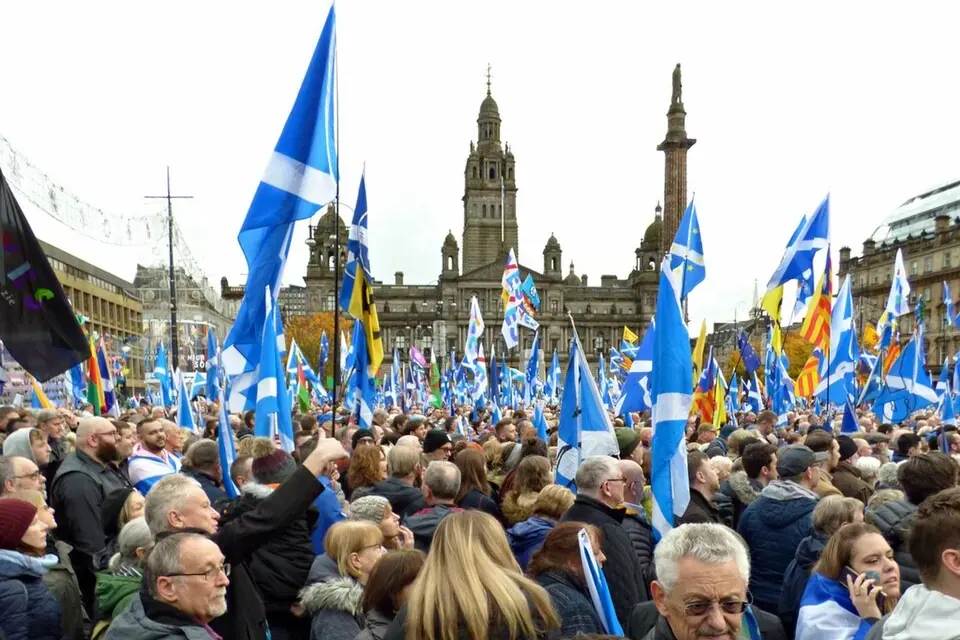
Hope over Fear, 2017
George Square, the 2014 anniversary and the 'power grab' argument over the EU Withdrawal Bill.
 Events in context
Edinburgh between referendums
Stalls in the Meadows, hubs and alliances: grassroots campaigning in a No-voting capital.