The Hope over Fear rallies and the 'tale of two referendums' in September 2017
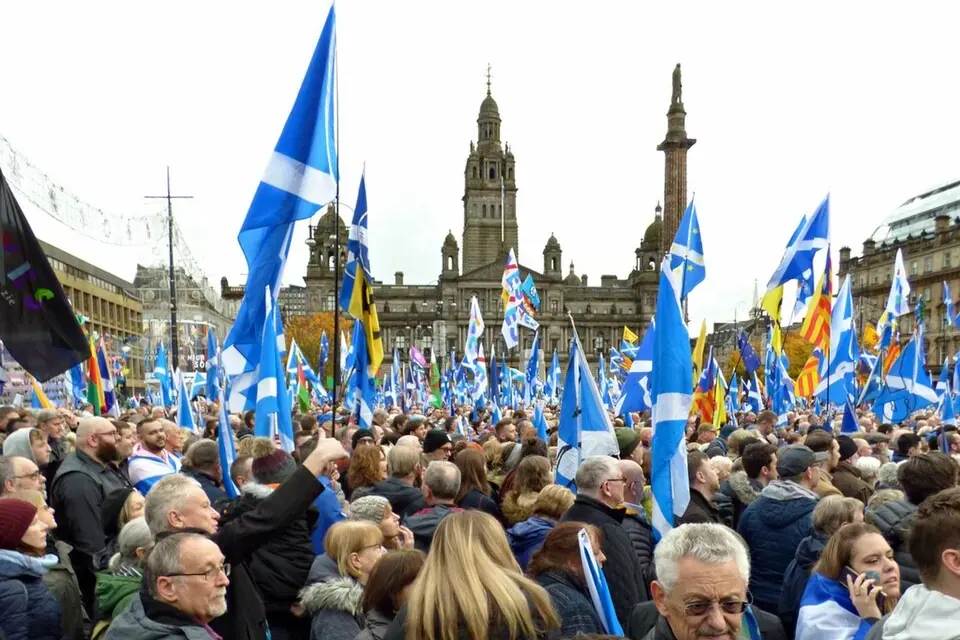
On Saturday 16 September 2017, two days before the third anniversary of the independence referendum, thousands of people gathered in George Square in Glasgow. The square had become a symbolic place for the Yes movement: Glasgow voted Yes in 2014, and the square had been the scene of large gatherings in the final days of that campaign. This article explains the rallies, who organised them, and the political context of 2017.
Glasgow's George Square
Glasgow was the largest of the four council areas that voted Yes in 2014, by 53.5% to 46.5%. In the last week of the campaign, George Square filled with Yes supporters, and some began calling it "Freedom Square". On the night after the result, the square also saw clashes when groups of unionists confronted Yes supporters, leading to arrests. The square therefore carries a mixed memory: of hope for one side, and of the tensions that a close contest can produce.
The Hope over Fear rallies
"Hope over fear" was a slogan of the 2014 Yes campaign, contrasting its message with what it called the "Project Fear" of the No side. After the referendum the name was adopted by a campaign associated with the former MSP Tommy Sheridan, which organised annual rallies in George Square around the anniversary of the vote. The rallies featured speeches from activists, musicians and representatives of smaller groups, rather than from the leadership of the SNP, which kept a distance from them. Other organisations, such as All Under One Banner, began organising marches through Scottish towns and cities from 2017 onwards.
Speakers at such events are usually arranged in advance by the organisers, and programmes change at short notice. Some groups that had hoped to send a speaker published their remarks online when they did not get a slot on the stage, a sign of how many different voices the movement contained by 2017.
A "tale of two referendums"
A theme of many speeches at the 2017 rally was the contrast between the 2014 referendum, which supporters of independence remembered as civic and participatory, and the EU referendum of 2016, whose aftermath saw a rise in reported hate crime in England and Wales and great uncertainty for EU citizens living in the UK. The comparison was partisan, and Leave voters in Scotland, about 38% of those who voted, did not recognise themselves in it. It nevertheless captured why many in the Yes movement saw Brexit as a turning point.
The "power grab" argument
The rally came days after the House of Commons voted on 11 September 2017, by 326 to 290, to give a second reading to the European Union (Withdrawal) Bill. Clause 11 of the bill, as first drafted, provided that powers returning from Brussels in devolved areas such as agriculture, fisheries and the environment would initially be held at UK level, with the devolved legislatures barred from changing retained EU law in those areas.
The Scottish and Welsh governments described this as a "power grab" and said they would recommend that their parliaments refuse consent. The UK government argued that UK-wide frameworks were needed to protect the internal market and that most powers would eventually be released. The bill was amended in 2018, and the Welsh Government agreed to the revised version, but the Scottish Government did not. The dispute led to the Scottish Parliament's refusal of consent in May 2018, covered in our article on what happened when Holyrood said no.
The bridges metaphor
A recurring image in independence rhetoric of this period was that of building bridges rather than burning them: presenting Scotland as an outward-looking country that wished to stay close to Europe while leaving the UK. Opponents replied that independence would itself create a new border with Scotland's largest trading partner, a point that became sharper once the UK had left the single market and customs union. The debate over the border, in trade and in identity, has remained central to the argument ever since.
What the rallies showed
Rallies are a poor measure of opinion: they mobilise committed supporters rather than the undecided voters who determine referendum results. Polls in September 2017 showed support for independence little changed from 2014, at around 45%. Their importance lies elsewhere: they kept networks of activists in contact, gave smaller groups a platform, and offered a public reminder that the question had not gone away.
Sources
- Glasgow City Council, declaration of the 2014 referendum result.
- House of Commons, Hansard, European Union (Withdrawal) Bill, second reading division, 11 September 2017.
- Scottish Government and Welsh Government, joint statement on the European Union (Withdrawal) Bill, 13 July 2017.
- Home Office, Hate Crime, England and Wales, 2016/17, October 2017.
- BBC News, reports on George Square rallies, September 2014 and September 2017.
 Explainers
Holyrood's refusal of consent
A 93–30 refusal, the Sewel convention, a walkout at PMQs and the Continuity Bill ruling.
 Events in context
Edinburgh between referendums
Stalls in the Meadows, hubs and alliances: grassroots campaigning in a No-voting capital.
 Explainers
The declaration of 27 October 2017
A 70–10 vote, Article 155 the same afternoon, and a declaration no government recognised.