Dumfries and Galloway and the independence question: a border region's politics
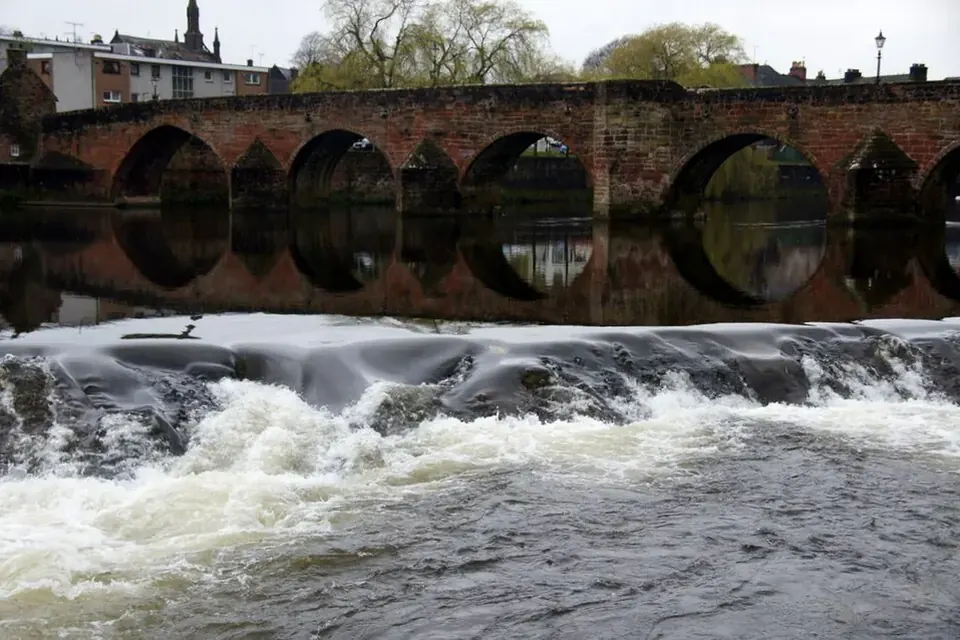
In May 2018, small pro-independence groups were announcing new local branches in parts of Scotland where the Yes vote had been weak. Dumfries and Galloway, the south-western council area that borders Cumbria, was one of them. The region is a useful case study for anyone trying to understand the geography of the constitutional debate.
Dumfries and Galloway in numbers
- Population: about 148,000, spread over some 6,400 square kilometres.
- 2014 referendum: No 65.7%, Yes 34.3%; turnout 87.5%.
- 2016 EU referendum: Remain 53.1%, one of the narrowest Remain votes in Scotland.
- Westminster seats (2017–2024): Dumfries and Galloway, and Dumfriesshire, Clydesdale and Tweeddale, both held by the Conservatives.
One of the strongest No votes
Dumfries and Galloway recorded one of the largest No majorities of the 32 council areas in 2014, behind only Orkney and the Scottish Borders. The pattern was typical of rural, older and more affluent areas in the south and north-east of Scotland, while the Yes vote was strongest in the former industrial areas of the west central belt. Proximity to England, strong family and economic ties across the border, and a population with a higher than average age all help explain the result.
A border region with many English-born residents
The south of Scotland has some of the highest shares of residents born in England of any part of the country. Many have moved for retirement, work or family. Survey research on the 2014 referendum found that people born elsewhere in the UK voted No by a large margin, so a high proportion of English-born residents tends to lower the Yes vote. For groups campaigning among English-born voters, regions like Dumfries and Galloway were therefore both an obvious target and a difficult one.
Cross-border links are part of daily life. The towns of Annan and Gretna are close to Carlisle, which serves as a regional centre for shopping, hospitals and rail connections, and many people commute across the border in both directions. During the referendum the possibility of a border with customs or passport checks was one of the most practical questions voters asked; after Brexit it acquired new force, since an independent Scotland in the EU would have a land border with a UK outside the single market.
Political representation
The region has been one of the few parts of Scotland where the Conservatives remained competitive throughout the devolution era. David Mundell, MP for Dumfriesshire, Clydesdale and Tweeddale from 2005, was the only Conservative MP in Scotland between 2005 and 2017 and served as Secretary of State for Scotland from 2015 to 2019. In 2015 the SNP's Richard Arkless won the Dumfries and Galloway seat, but in 2017 it was taken by the Conservative Alister Jack, who later succeeded Mr Mundell as Scottish Secretary. At Holyrood, the Conservatives won the Dumfriesshire and Galloway and West Dumfries constituencies in 2016.
The SNP and other pro-independence parties have nonetheless had a strong presence on the council and in the regional list seats of the South Scotland region, and the area has an active network of political and community groups of all persuasions.
Why groups organise here
For a campaign group, opening a branch in an area where its cause is unpopular serves several purposes. It gives existing supporters, who may feel isolated, a local contact and a place to meet. It allows arguments to be tested on a sceptical audience. And it helps a national organisation present itself as representative of the whole country, not only of the cities where it began. Unionist organisations have followed the same logic in reverse, building local activity in Glasgow and Dundee.
The weakness of local branches in thinly populated areas is also clear: distances are long, volunteers are few, and activity often depends on one or two people. Many branches formed in this period remained small, and some ceased to be active when their organisers moved on.
A test for the future
Any future referendum is likely to be decided by shifts among groups and places that voted No in 2014. Polling after 2016 suggested that some Remain-voting No voters had moved towards independence, while some Leave-voting Yes voters had moved the other way. In a region that voted narrowly Remain and strongly No, with an older population and close ties to England, those cross-currents were particularly visible. Dumfries and Galloway is therefore less a bellwether than a measure of how far either side can reach beyond its heartlands. For a comparison with the capital, see our article on Edinburgh in 2017.
Sources
- Dumfries and Galloway Council, declaration of the 2014 referendum result.
- Electoral Commission, EU referendum results by counting area, 2016.
- National Records of Scotland, mid-year population estimates for council areas.
- Scotland's Census 2011, country of birth by council area, scotlandscensus.gov.uk.
- House of Commons Library, results of the general elections of 2015 and 2017.
 Events in context
Edinburgh between referendums
Stalls in the Meadows, hubs and alliances: grassroots campaigning in a No-voting capital.
 Arguments
The case put to England in 2014
Anti-English feeling, 'subsidy junkies', oil, the pound and pensions: the claims, and what the record shows.
 Events in context
Hope over Fear, 2017
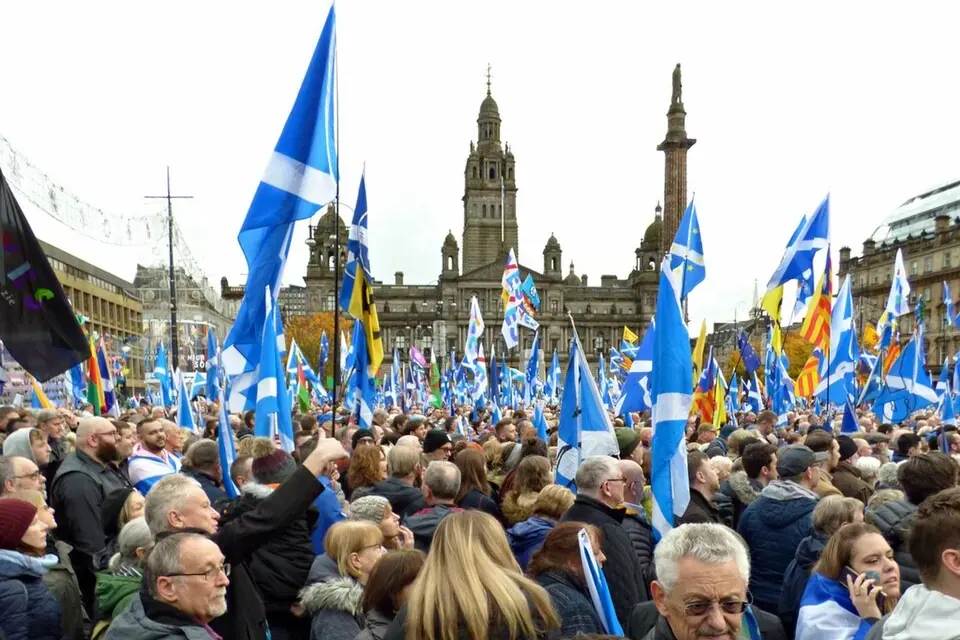
George Square, the 2014 anniversary and the 'power grab' argument over the EU Withdrawal Bill.