St Andrew's Day 2026: why Scotland's national day is a bank holiday that most people still work
Next Monday, 30 November, is St Andrew's Day, Scotland's official national day. Since 2007 it has also been a bank holiday. Yet most people in Scotland will go to work, children will go to school and the banks will open as usual. That apparent contradiction says a lot about how a bank holiday works in Scots law, and about the modest compromise behind the day.
What the 2007 Act did, and did not do
The St Andrew's Day Bank Holiday (Scotland) Act 2007 is a very short statute. According to its official text, the bill was passed by the Scottish Parliament on 29 November 2006, the eve of St Andrew's Day, and received Royal Assent on 15 January 2007. Its stated purpose is simply "to establish a bank holiday for St Andrew's Day".
A bank holiday in Scotland is a legal category with limited effects. It concerns financial and legal business, such as the days on which bills fall due, rather than a general right to time off. The Act did not oblige employers to give staff the day off, nor did it add a day to anyone's statutory annual leave. Whether a worker gets 30 November off depends on their contract, their employer or a collective agreement. As the reference account of the day notes, banks are not required to close and in practice stay open, and schools remain open too.
The Act also includes a weekend rule: when 30 November falls on a Saturday or a Sunday, the following Monday becomes the bank holiday instead. In 2026 the question does not arise, since the date is a Monday, as the Scottish Government's list of bank holidays confirms. In 2027 it falls on a Tuesday.
Why the law was written that way
The bill came from a campaign to give Scotland's national day more weight in public life. What reached the statute book was deliberately light. Scotland already has its own pattern of public holidays, with many of them fixed locally by councils rather than nationally, and an extra compulsory day off would have had a cost for employers. The Act therefore created the bank holiday and left the question of time off to employers and employees. Supporters could present it as a symbolic first step; critics could call it a holiday in name only. Twenty years after the vote, both descriptions still hold.
In practice, the day is observed most visibly through flags on public buildings and through cultural events organised around the date. The University of St Andrews has traditionally given its students the day off, though this is a custom rather than a binding rule.
Who was St Andrew, and why Scotland?
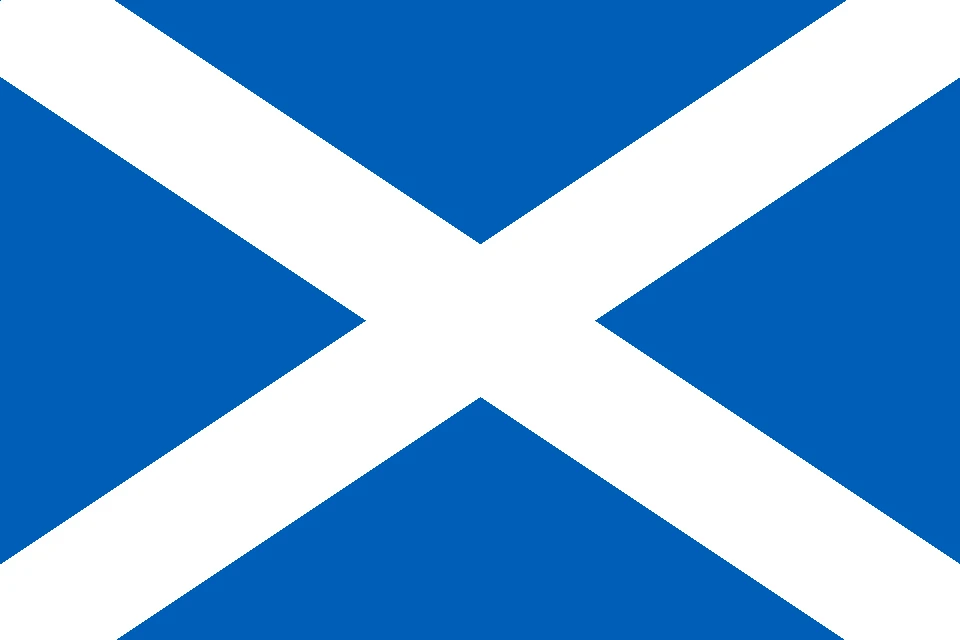
Andrew was one of the twelve apostles, the fisherman who, in the Gospel accounts, introduced his brother Peter to Jesus. Christian tradition holds that he was martyred at Patras in Greece on an X-shaped cross, which is why the diagonal cross bears his name. He is also the patron saint of several other countries, including Greece, Romania, Russia, Ukraine and Barbados, where 30 November is the national independence day.
The link with Scotland is old. The Declaration of Arbroath of 1320 already presents Scotland's conversion to Christianity as the work of St Andrew, and seals showing the saint on his cross appear from the late twelfth century, according to the history of the Scottish flag. The best-known story, which places the origin of the Saltire on the eve of a battle at Athelstaneford in East Lothian in 832, is a legend rather than documented history.
The Saltire on 30 November
St Andrew's Day is an official flag day in Scotland. Under the Scottish Government's flag-flying arrangements, the Saltire flies on its buildings, and on buildings with a single flagpole it replaces the Union Flag for the day. The Union Flag continues to fly over Edinburgh Castle, an Army flag station, a choice that some politicians have criticised over the years. For readers following the constitutional debate, this is a small but telling example of how the two flags, and the two levels of government, share symbolic space.
One saint, many countries
Scotland is far from alone on 30 November. In Romania, where Andrew is also the patron saint, the day has been a national public holiday since 2015, a full day off rather than a bank holiday. In Poland, the eve of the feast is Andrzejki, a night of fortune-telling games once reserved for young unmarried women, in which hot wax is poured through the hole of a key into cold water and the shape is read as a sign of the future. In Barbados, the date coincides with independence day. Set against these traditions, Scotland's version is a quieter, more civic affair: flags, events and a legal holiday that most people notice only in their diaries.
The start of a winter season
For many Scots the day matters less as a holiday than as the opening of a run of winter dates: St Andrew's Day, then Hogmanay, then Burns Night on 25 January. St Andrew's Day is often presented as the first of Scotland's winter festivals, marked with ceilidhs, traditional food and music in Scotland and in Scottish communities abroad. Expect also the annual debate about whether the day should become a full public holiday, which resurfaces most years without changing the law.
For the institutions behind those debates, see our explainers on what changed after the 2014 referendum and on the 2014 and 2016 votes council by council.
Sources
- St Andrew's Day Bank Holiday (Scotland) Act 2007 (asp 2), legislation.gov.uk, introductory text.
- mygov.scot, Scotland bank holidays 2026 and 2027, consulted 24 November 2026.
- Wikipedia, "St Andrew's Day" and "Flag of Scotland", consulted 24 November 2026.